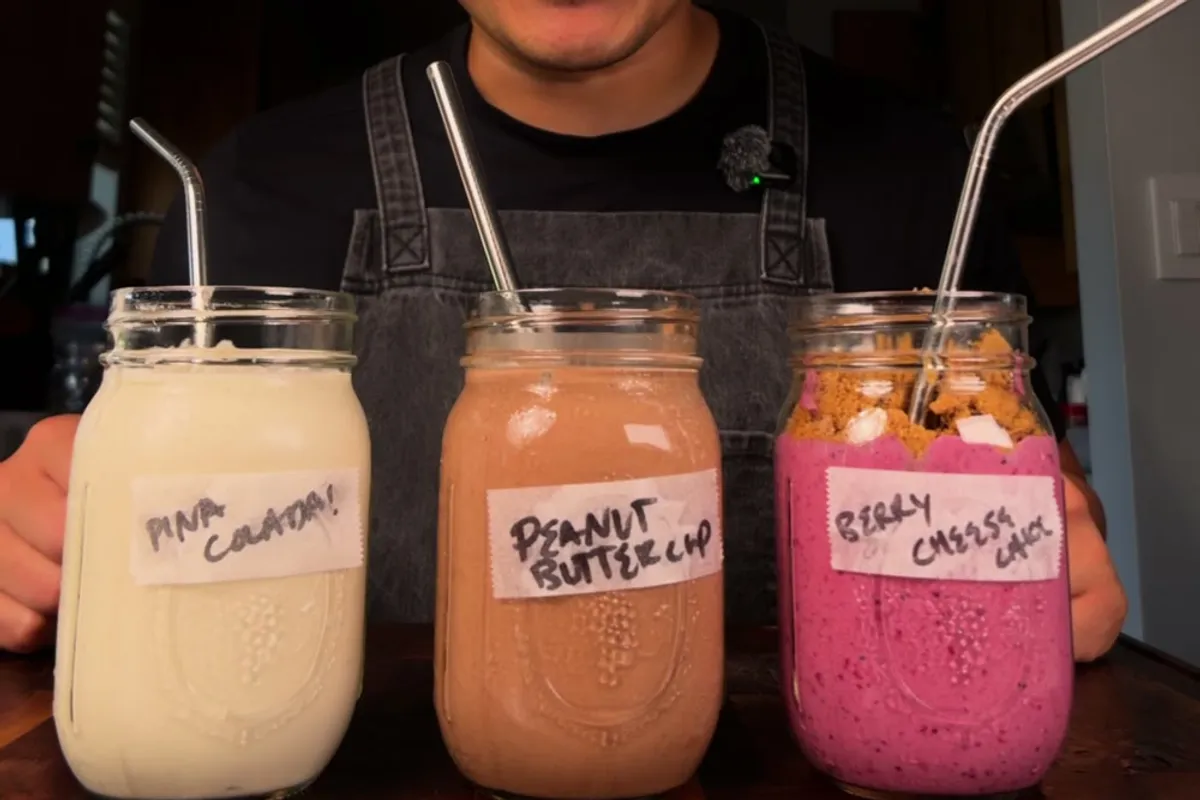
A smoothie goes wrong two ways: it comes out thin and watery, or it is a sugar bomb that leaves you hungry an hour later. Both come from the same two mistakes, ice instead of frozen fruit, and juice instead of a creamy base. One formula fixes both.
A great smoothie is not fruit and ice. It is frozen fruit for thick flavor, a creamy fat-and-protein element for body, just enough liquid, and a pinch of salt and acid, one formula, three smoothies.

A smoothie goes wrong two ways: it comes out thin and watery, or it is a sugar bomb that leaves you hungry an hour later. Both come from the same two mistakes, ice instead of frozen fruit, and juice instead of a creamy base. One formula fixes both.
About 2 parts frozen fruit : 1 part creamy : 1 part liquid. No ice. Plus a pinch of salt and a squeeze of acid. That is the whole thing, and the three smoothies at the bottom are all just that formula with different fruit and a different creamy element.
Ice and frozen fruit both make a smoothie thick and cold. The difference is flavor. Ice does thicken while it is still frozen, but it is frozen water, so it melts to plain water, and the drink thins and mutes the longer it sits and the more you sip. Frozen fruit is the fruit itself, frozen, so it brings pulp, fiber, and flavor, it thickens and flavors at the same time. Freeze your fruit, skip the ice, and it is thicker and tastes more like fruit. (One practical note: because frozen fruit thickens so well, you control the texture with the liquid, not with ice.)
This is what separates a smoothie from cold juice. A scoop of Greek yogurt, nut butter, cream cheese, or coconut cream gives the drink a rich, creamy body and carries flavor, since a lot of flavor is fat-soluble. It is worth knowing which ones bring protein: Greek yogurt, milk, and nut butter add real protein and make the smoothie filling, while coconut cream and cream cheese add richness and fat but very little protein. Either way, the fat and protein also blunt the blood-sugar spike you would get from a juice smoothie. They do not erase it, and your total sugar still counts, but a smoothie built this way lands a lot softer than a glass of juice.
Liquid (milk, coconut water, a splash of juice) is only there to get the blender moving. Add it last, a little at a time, and stop the second it is blending. Frozen fruit thickens, liquid thins, so let the fruit do the work or you are right back to watery.
Same trick as everywhere else in the kitchen: a truly tiny pinch of salt makes the fruit taste more like fruit. Sodium quiets bitterness and nudges the sweetness forward, so the smoothie reads brighter and a touch sweeter without any added sugar. The lift is subtle, and it matters most if you blend in greens like kale or spinach, whose bitterness the salt cuts. Keep it to a real pinch though, any more and it just tastes salty and flattens the fruit.
A little lemon or lime brightens the whole thing and balances the sweetness so it does not go flat or cloying. It also slows browning, so the color stays fresh, which matters most for banana, apple, and pear (berries mostly hold their own color). Lemon has a bit more browning-fighting vitamin C than lime.
Liquid and the soft stuff (yogurt, nut butter) go in first, frozen fruit on top. Blend, and only dribble in more liquid if it stalls. Taste, hit it with the salt and acid, done.
It is not really the ice, it is the sugar. Shop smoothies build their body and sweetness from fruit juice, sherbet, sorbet, or frozen yogurt, plus added sweeteners like turbinado sugar and honey. That is how a drink marketed as healthy ends up north of 20 teaspoons of sugar. Your formula gets its thickness from frozen fruit and its body from a creamy protein instead, so it is just as thick and far more filling, with a fraction of the added sugar.
About 2 to 2.5 cups, one serving. Roughly 520 calories, 20g protein.
About 2 cups, one serving. Roughly 375 calories, 10g protein.
About 2.5 cups, one serving. Roughly 340 calories, 15g protein.
A great smoothie is not fruit and ice. It is frozen fruit for thick flavor, a creamy fat-and-protein element for body and staying power, just enough liquid, and a pinch of salt and acid to make it pop. Get that, and you will never pay twelve dollars for a watery sugar bomb again.
New food science article every week. Sign up free to get notified, or go ad-free with membership.
Remove all ads across the site, unlock chef's notes and dietary substitutions, and support the science content that keeps coming.
Get Membership