The Wok Buying Guide: What to Buy, and What Not to Pay For
A good wok costs $15 to $50, and a $17 one is the same steel as a $189 one. Here is what a wok is built to do, what actually matters when you buy one, and everything you are overpaying for.
Charles Kim·Chef Fatty
August 5, 2026
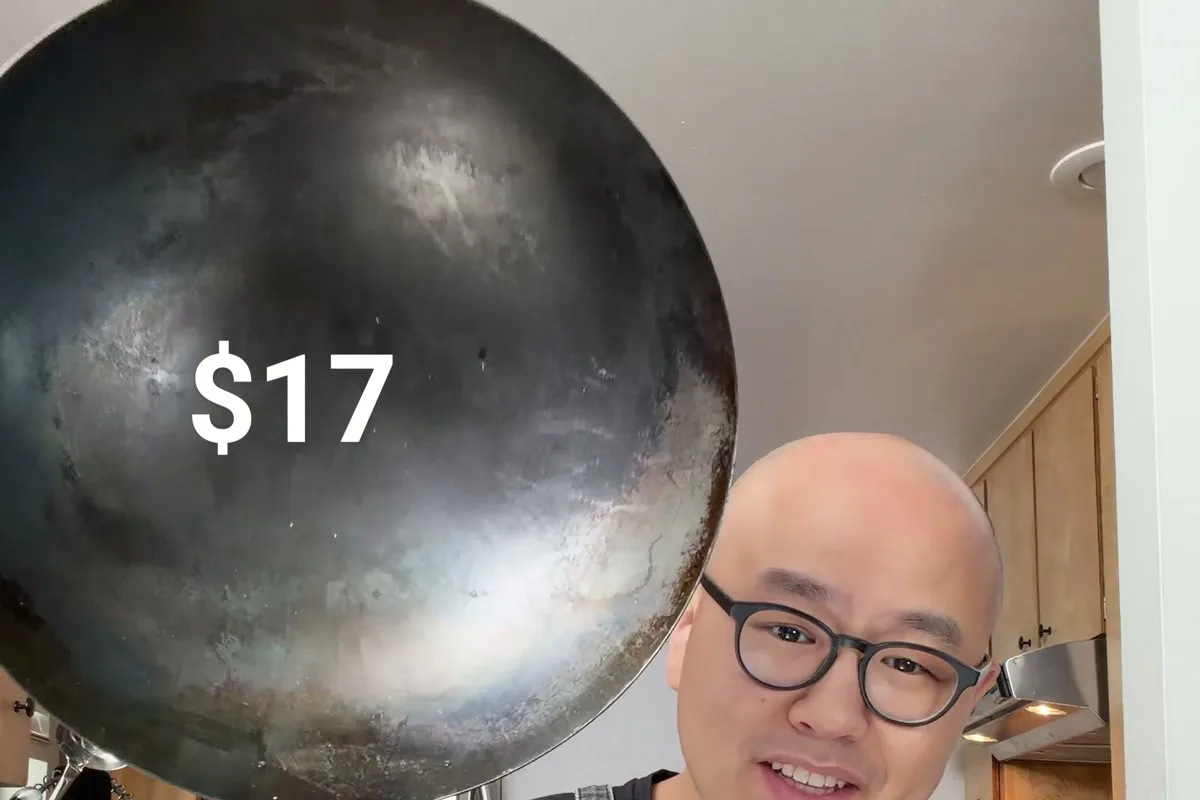
This is a $17 carbon steel wok. It stir-fries as well as one that costs ten times more. This is why, plus how to buy and keep one.
The wok aisle is full of woks that cost as much as a car payment, hand-hammered, nitride-treated, lidded, branded. Almost none of it makes your food better. To see why, you have to start with what a wok actually is and what it was built to do, because the shape and the steel explain every buying decision that follows.
What a wok is actually for
The wok goes back roughly two thousand years, to Han-dynasty China (about 200 BCE to 200 CE), archaeologists have pulled little pottery wok models perched on toy stoves out of Han-era tombs. And it was born from a very practical problem: fuel was scarce. Wood and charcoal were precious, so cooks needed a pan that could turn a small, quick fire into a finished meal. The answer was a thin, round-bottomed bowl that nestles down into the fire so the heat wraps up its sides, and, being thin, reacts to that heat instantly. Little fuel, lots of cooking, fast.
The early wok, though, was used mostly for drying and parching grains, not the stir-fry it is now famous for. The screaming-hot stir-fry we picture today came into its own much later, around the Ming dynasty (roughly six hundred years ago), when metal woks and cooking oil became widely available and fuel near the growing cities got expensive enough that fast, hot, efficient cooking became the whole game.
That shape also makes the wok the most versatile pan in the kitchen. The same bowl stir-fries (its signature), but it also deep-fries on less oil than a flat pan (the curve pools it in the center), steams over a rack, braises, and even smokes. And the sloped sides give you something a flat pan cannot: a temperature gradient. The bottom is a searing zone, the walls are cooler. Good wok cooks work both, blast aromatics and protein in the hot center, then push them up the sides to hold while the next thing sears. You are not fighting the uneven heat, you are conducting it.
The curved walls give you a searing center and a cooler rim to push food up to. That gradient is the wok's whole trick.
In a restaurant, that fire is a jet burner putting out roughly ten times what your home stove can, with the round wok nestled right down in the flame. That is the environment the wok evolved for, and the gap between that kitchen and yours is exactly what the wok aisle is quietly selling you fixes for.
First, is a wok even right for you?
That gap between a restaurant's fire and your kitchen is really the whole question, so before you buy anything, be honest about your stove. For a lot of home cooks a wok is the wrong tool, and no wok at any price fixes that.
If you cook on electric or induction, you can probably skip the wok. There is no flame, so you lose the smoky flame-note that defines wok hei, a round bottom barely touches a flat element, and a good preheated skillet will sear a stir-fry about as well. Your money is better spent elsewhere.
If you cook on a home gas stove, a wok works, but be honest about how much it adds. Your burner is a fraction of a restaurant's fire, so it only performs with technique: small batches (about half a pound), a hard preheat until the empty wok smokes, and constant tossing. Crowd it and it just steams. Do all that and you get a good stir-fry, but a skillet you already own gets you most of the way there. The wok's real edges are modest: a little more room to toss, tall sides that catch splatter, and deep-frying on about a third less oil. And it still will not give you true, roaring restaurant wok hei. On a home stove a wok is a nice-to-have, not a game-changer.
What about the torch trick? A kitchen torch chases the smoky, flame-charred part of wok hei, and that part is real, but a torch cannot sear food against hot metal the way the pan does, and you can wave it over any dish. It is a fun finishing move, not a substitute for heat.
So the real limit is your stove, not your wok. The one upgrade that actually unlocks restaurant-style wok cooking is more fire, an outdoor high-BTU burner, which is exactly why the rest of this guide keeps the wok cheap. Put the money into heat, not the pan.
Stop overpaying
A good wok costs about fifteen to fifty dollars. A $17 restaurant-supply carbon steel wok is made of the same steel, about the same thickness, as a wok that costs $150 or more. Across the price range, quality woks are plain carbon steel around 1.5 to 2 mm thick, and every serious reviewer agrees the cheap one stir-fries just as well. What the extra money buys you is craftsmanship, a nicer handle, extras, and a brand name, not better cooking.
And for everyday stir-fry, you do not need a restaurant jet burner either. A cheap carbon steel wok, cooked in small batches, sears just fine on an ordinary gas stove. So the real scam is not that woks are useless at home, it is being sold a $200 pan to do a job a $30 pan does just as well.
Buy carbon steel, and basically nothing else
Carbon steel is the answer, for the same reasons it always was: it is thin and responds to heat changes very quickly, it seasons up to a practically nonstick surface, and it is cheap. The other materials are wrong for a wok:
Nonstick is a non-starter. The coating (PTFE) starts breaking down above about 500°F and off-gasses badly above roughly 660°F, and real wok cooking drives the surface well past that. You would destroy the coating on the first proper stir-fry.
Stainless steel will not season, so nothing keeps food from sticking under wok heat.
Heavy cast iron (the Western kind) is too heavy to toss and too slow to change temperature, which kills the fast heat control that makes a wok a wok.
Thin is the point (within reason)
The sweet spot is about 1.5 to 2 mm (14 to 16 gauge) carbon steel. Thin steel heats and cools fast, and that responsiveness is control. But there is a real floor and a real ceiling. Go thinner than 1.5 mm (the flimsy stamped stuff) and it develops hot spots and warps. And thicker woks are not just a crutch for weak burners, whatever you may have heard. Heavier steel (2 mm and up) resists warping on very high-output jet burners and banks more heat for searing, which is exactly why restaurant woks are heavier. A bigger burner pushes you toward thicker steel, not thinner. For a home stove, 1.5 to 2 mm is right.
Match the bottom to your stove
This is the one that actually matters for a home cook. A round-bottom wok is built to sit down inside a ring of flame. On a flat home stove it cannot do that, so it needs a wok ring for stability, and the ring lifts the wok up off the burner, costing you heat on a stove that did not have much to spare. On electric or induction it is worse: almost no contact, and induction will not even turn on for it.
On a home stove a round bottom rides up on a ring, away from the flame. A flat bottom sits right in the heat.
So for a home stove, buy a flat-bottom carbon steel wok, ideally one with a decently wide flat base (about 6 to 7 inches) so it gets real contact with the burner. It is the standard advice for home stir-frying now, and it beats trying to make a round-bottom work indoors.
What you are actually overpaying for
These are the features the premium woks lean on. None of them cook better:
Nitride (the "rust-proof" surface). This one is real. Nitriding is not a coating (it is nitrogen diffused into the steel, so it cannot chip or peel), and it genuinely resists rust and needs almost no seasoning upkeep. But it is a durability and convenience perk, not a flavor one. The tradeoff is that the same hardened surface takes seasoning more slowly, and a plain carbon steel wok kept happy with a 60-second habit does the same job for a fraction of the price. Worth having, not worth a big premium.
Hand-hammered dimples. The texture does help you push food up the sides a little, but the benefit is marginal and most home cooks will never notice it. And plenty of cheap woks fake the look with a machine-pressed pattern anyway (the tell: hammer marks that never overlap).
A lid. A nice extra, not an upgrade. You can usually cover a wok with a lid you already own.
Brand and looks. Pure markup.
But do not go too cheap either
There is a floor. The thing to actually avoid is the flimsiest stamped woks, roughly 18 to 20 gauge (about 0.9 to 1.2 mm). They heat unevenly, develop hot spots, and can warp for good under high heat. As for the handle, a riveted one is a little more durable than a welded one over years of hard heat, but a solid welded handle (what a lot of good cheap woks have, including mine) is perfectly fine. Construction quality matters more than the attachment method. So the target is a carbon steel wok, about 1.5 to 2 mm, in the $15 to $50 range.
Season it, then keep it alive
Carbon steel asks for one thing in return for being cheap and slick: a little care, or it rusts. The good news is the whole routine takes about sixty seconds, and unlike a nonstick pan that only gets worse, a wok gets better every time you use it.
Seasoning is not something you buy, it is something you build. It is a layer of oil baked onto the steel until it polymerizes into a hard, black, slick surface, and that layer is both your nonstick and your rust barrier. It thickens a little every time you cook. When a wok is sold as "pre-seasoned," all that means is the factory gave it the first coat. You still build the rest.
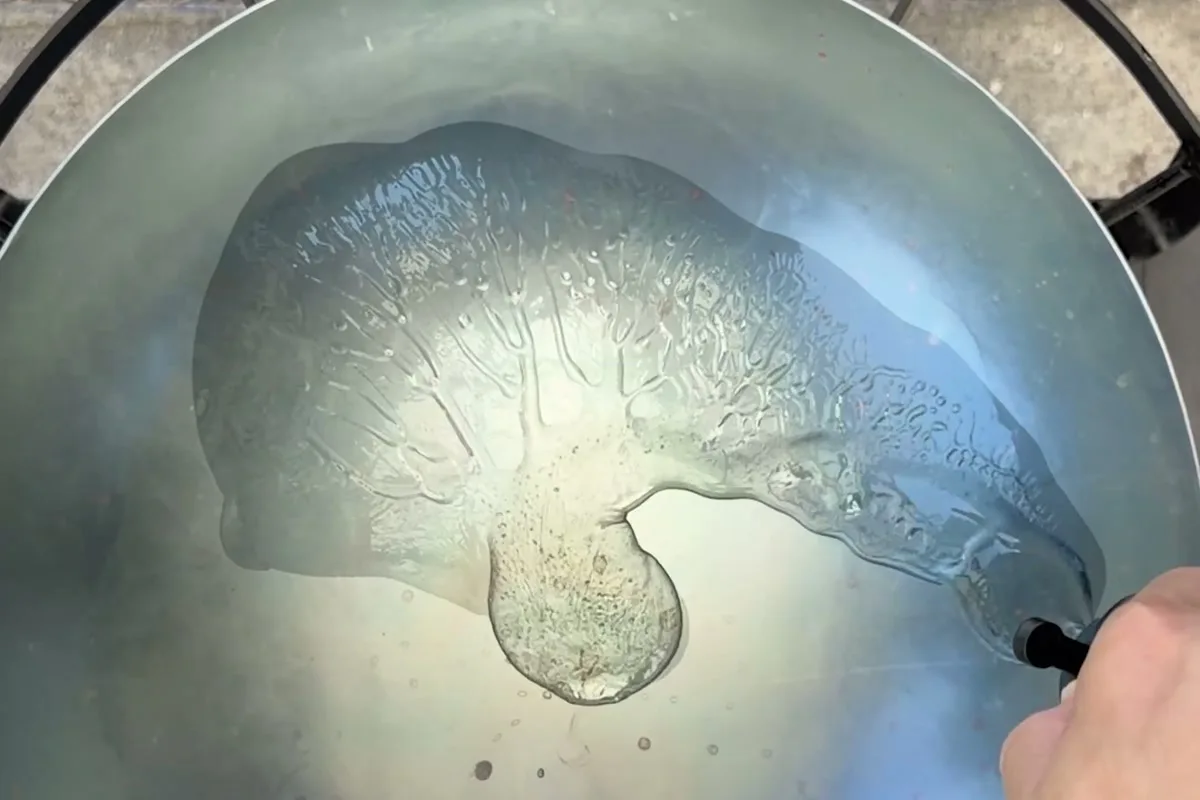
The first time, strip it and lay the base. A new wok ships with a factory anti-rust film, so scrub it off with hot water, soap, and a scouring pad (the one and only time soap and steel wool belong anywhere near a wok). Then dry it and build the first layer: heat the empty wok until the steel changes color and blues, wipe on a very thin film of a high-smoke-point oil, and heat it until it stops smoking. Repeat for a few thin coats.
A thin film of oil heated onto the steel until it polymerizes. The blue is the steel tempering under the heat. Thin is everything, too much oil bakes into a sticky, flaky mess.
After every cook, the sixty-second habit. While the wok is still warm, rinse it with hot water and a soft sponge or a bamboo brush. A little dish soap is fine, a properly seasoned surface is bonded to the steel and soap will not lift it, just skip the steel wool and hard scouring, which strips the patina you are trying to grow. Then do the one step that actually matters: dry it completely. Set it back on the burner for a minute to drive off every trace of water, then wipe a whisper of oil around the inside. That film is your rust insurance.
Months of use build a mottled bronze-and-black patina like this. That is a well-loved wok, not a dirty one.
Rust happens, and it is not the end. Carbon steel is rust-resistant, not rust-proof, even the nitrided "rust-free" ones (that label is marketing). Find a rust spot, scrub it off with a scouring pad, wash, dry, and re-season that patch. Good as new. A wok is almost impossible to actually ruin.
Storage, and the wet jobs to go easy on. Keep it dry with a thin film of oil, somewhere air can reach it, not sealed in a damp cabinet. And go easy on water: long boiling, simmering, and blanching slowly lift the seasoning and, left wet, start rust, so boil noodles and blanch vegetables in a regular pot, not your wok. Acidic liquids (tomato, wine, vinegar, citrus) strip it even faster. Steaming is the traditional exception, but it can lift a fresh patina too, so save it until your wok has built up a tough black layer, and dry it over the burner afterward. And do not store food in it.
And wok hei is not hiding in an expensive wok
Wok hei, the smoky, charred flavor people chase, is not some magic sealed inside a pricey pan. Any $20 wok can carry it. It comes from very high heat doing two things at once: the browning (Maillard and caramelization) of food, sauce, and oil against the screaming-hot metal, and the smoky compounds thrown off when vaporized oil catches in the flame, the so-called breath of the wok. Food scientists genuinely argue over which of those matters more, and no one has cleanly measured the split, so anyone who tells you it is all one or all the other is guessing. What is not in question: it comes from heat and fire, not from the brand on the pan. The wok is never your limiting factor. Your heat is.
The setup I actually use
The whole point here is that the pan is cheap. So here is my real setup, and the one upgrade actually worth paying for.
The heat is the real upgrade. A home burner puts out around 7,000 BTU, which is not enough to get the true smoky char of restaurant wok hei. If you want to chase that, spend your money on fire, not on a fancier pan.
Start here: Camp Chef Pro 30. A 30,000 BTU single burner with fold-out legs. Roughly four times your stove, portable, and not intimidating. Plenty for most people.
Go big: Bayou Classic Dual Jet Cooker. 367,000 BTU of full restaurant jet heat. Overkill for most, but it recreates the roaring wok station.
One safety rule: these burners are propane and strictly for outdoors (a patio, driveway, or open garage). Never run a high-output propane burner inside. That is a carbon monoxide risk, not just a smoke-alarm one.
The burner links are affiliate links. They cost you nothing extra and help keep the recipes free.
The bottom line
Buy a carbon steel wok, about 1.5 to 2 mm, $15 to $50 (flat-bottom for a kitchen stove). Season it and keep it dry. Skip the nitride premium, the hand-hammering, the lid, and anything over about $50. You do not need a $200 wok, and you do not need a jet burner to cook a great stir-fry. The one upgrade worth paying for is heat, not a fancier pan.
Weekly articles
Enjoy the science? There's more every week.
New food science article every week. Sign up free to get notified, or go ad-free with membership.