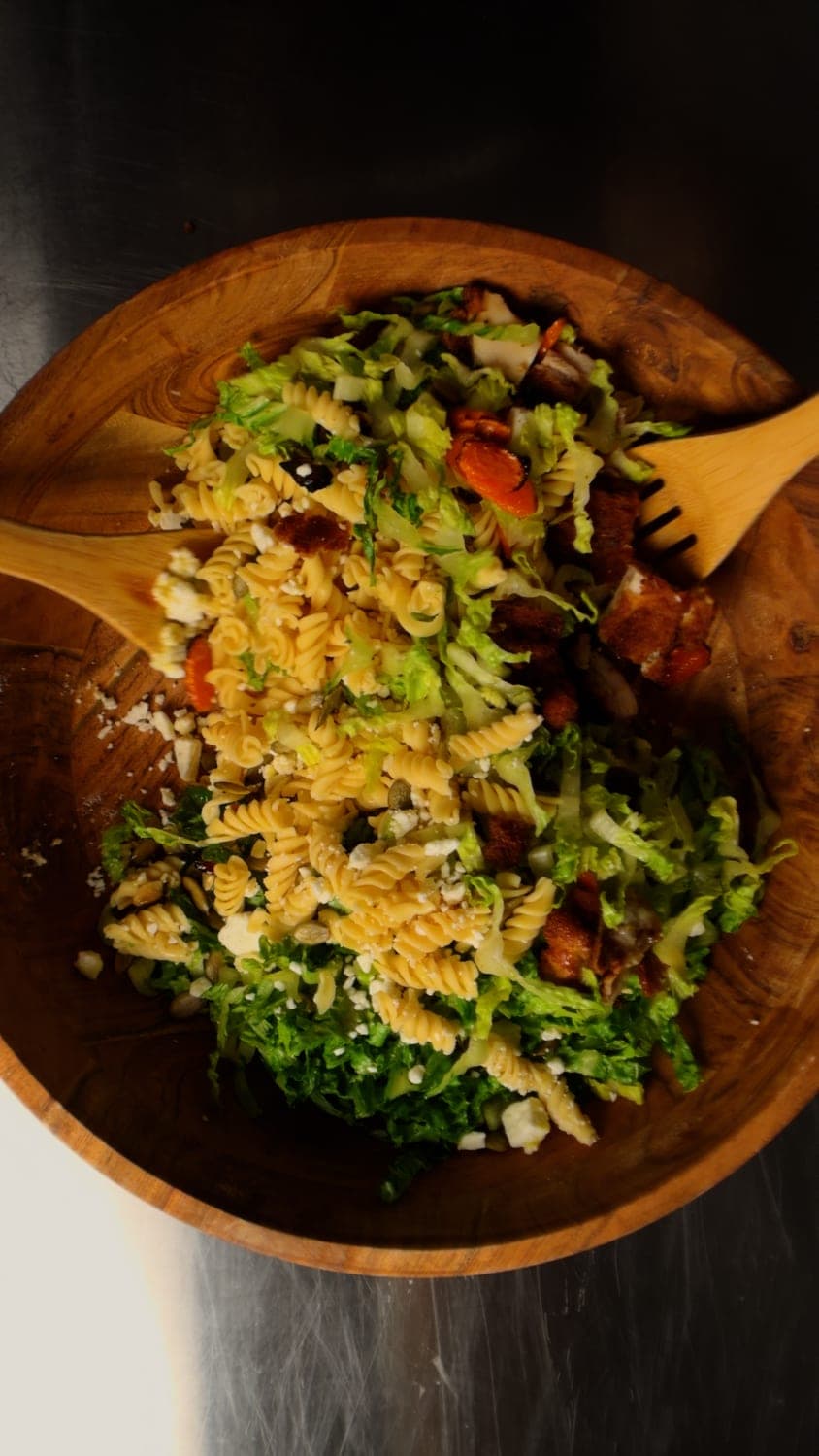
The Seven Flavor Pillars: A Sensory Framework for Maximizing Flavor
Most home cooking hits two of the seven flavor pillars. Restaurant cooking hits all seven. The difference is not talent. It is a framework. Here are the seven sensory channels every great dish activates, and the peer-reviewed neuroscience behind each one.

Charles Kim·Chef Fatty
June 9, 2026
You don't have a cooking talent gap. You have a framework gap.
Most home cooks make food that hits two flavor pillars. Sometimes three. That is why three bites in, the dish gets boring. The brain has stopped responding to it.
Every restaurant dish you can't stop thinking about hits seven. Not because the chef is more talented. Because the chef is unconsciously applying a framework that home cooks rarely name.
I call it the seven S's. Smell. Sweet. Salty. Sour. Savory. Spice. Sensation. Seven sensory channels in your brain. Miss one and the dish reads as incomplete. Hit all seven and every fork lands like a real meal.
This article is the science behind why that works. Each pillar maps to a specific neural pathway, with peer-reviewed research backing it. Skip to the paper citations at the bottom if you want to verify any of it yourself.
Why flavor is a brain construction, not a tongue reading
Flavor is not what your tongue detects. Flavor is what your brain assembles by combining signals from taste, smell, touch, temperature, and even sound. The classic "five basic tastes" framework (sweet, sour, salty, bitter, umami) is just the tongue. It misses most of what actually makes food feel good to eat.
Charles Spence at the Oxford Crossmodal Research Laboratory has spent two decades mapping how the brain integrates these multisensory signals into a single experience we call flavor (Spence 2015, Cell · PMID 25815982). His framing: every additional sensory channel you activate compounds the perceived flavor of the dish. Hit one channel and the dish tastes flat. Hit seven and the brain reads it as deeply satisfying.
That is the foundation. Now the seven channels.
Seven pillars, four sensory systems
Before walking through each pillar, one structural point worth grounding. There are seven pillars, but they do not all come from the same place in the body. They map to four distinct sensory systems, each with its own receptors and its own neural pathway to the brain.
| Sensory system | Pillars it covers |
|---|---|
| Tongue (taste buds) | Sweet, Salty, Sour, Savory |
| Nose (olfactory receptors) | Smell |
| Pain neurons (TRPV1 / TRPA1) | Spice |
| Mechanoreceptors (texture sensors in the mouth) | Sensation |
The four taste-bud pillars are four of the five basic tastes the tongue can detect. The fifth is bitter, which the framework deliberately leaves out. You want to suppress bitterness in a dish, not amplify it (which is why salt does so much work — sodium ions block bitter receptors directly).
That is the whole framework expressed differently: hit four distinct sensory systems and you saturate every channel the brain uses to read food. Miss a system and the dish reads as thin. The pillars below are the practical handles for activating each channel.
1. Smell
The largest single contributor to what you call "taste" is actually smell. When you chew, volatile compounds travel up the back of your throat to the olfactory bulb in your brain (called retronasal olfaction). This is why food tastes bland when you have a head cold. Your nose, not your tongue, is doing most of the work.
Gordon Shepherd's foundational paper showed that the olfactory system contributes the majority of flavor perception in healthy adults (Shepherd 2006, Nature · PMID 17108956). Retronasal smell is what separates a great tomato from a mediocre one, far more than the four taste qualities the tongue can detect.
How it shows up in cooking: fresh herbs added at the end (basil, cilantro, dill, mint, scallion), citrus zest, freshly cracked black pepper, garlic, toasted spices. Anything aromatic added late, while heat is still alive but not destructive. Volatile compounds vanish in seconds, so this is the last move, not the first.
2. Sweet
Sweetness is not about dessert. In a balanced dish, sweet is the counterweight to sour and bitter. A small amount of sweetness lowers your perception of sharpness and softens the edge of an aggressive vinaigrette without making the dish taste sweet.
The taste interaction literature documents this clearly: sweet stimuli suppress perception of sourness and bitterness in mixed solutions (Green et al. 2010, Physiology & Behavior · PMID 20800076). A teaspoon of honey in a vinaigrette does not taste like honey. It tastes like balance.
How it shows up in cooking: caramelized vegetables (roasted carrots, sweet potato, onions), a small touch of honey or maple in a dressing, dried fruit in a savory dish, naturally sweet aromatics like roasted garlic. The sweet pillar is a balancing tool, not a flavor in its own right.
3. Salty
Salt does two distinct things at the same time. It amplifies your perception of sweetness, and it suppresses your perception of bitterness. One ingredient, two simultaneous jobs.
The mechanism is specific. Sodium ions enhance the firing of sweet taste receptors and block the T2R family of bitter receptors directly (Breslin & Beauchamp 1995, Chemical Senses · PMID 8788095). This is why a salted caramel reads as sweeter than a plain one, and why salt makes bitter vegetables like kale and broccoli edible.
How it shows up in cooking: cured meats (prosciutto, bacon, anchovy), salty cheeses (feta, parmesan, blue), olives, capers, soy sauce, miso. Plus the salt you season with directly. The pillar is not just "did you salt the dish." It is "is there a distinct salty element your brain can pick up in a single bite."
4. Sour
Acid is what keeps rich food from feeling heavy after three bites. Sour stimulates saliva, which physically resets your palate. Without it, fat coats your tongue and the brain stops registering new flavor.
Taste mixture studies show acid acts as a perceptual reset across mixed-flavor systems, reducing the dominance of fat and salt in repeated tasting (Green et al. 2010, Physiology & Behavior · PMID 20800076). This is why every chef finishes a rich dish with lemon, vinegar, or pickled vegetables.
How it shows up in cooking: a real vinaigrette (not the bottled kind), lemon juice at the end, pickled red onion or pickled chili, fermented vegetables (kimchi, sauerkraut, kraut), tomato in a heavy meat dish. The pillar fails if the acid is dull. Use fresh citrus or a quality vinegar, never the cheapest bottle on the shelf.
5. Savory (Umami)
Umami is the fifth basic taste, formally validated in the early 2000s after being identified by the Japanese chemist Kikunae Ikeda in 1908. It is the taste of glutamates, the amino acids that signal "this is protein-rich, eat it."
The receptor was characterized by Chandrashekar and colleagues in the Zuker lab: a heterodimer of T1R1 and T1R3 proteins that fires specifically in response to glutamate and a small set of related amino acids (Chandrashekar et al. 2006, Nature · PMID 17108952). It is a dedicated channel, as distinct from sweet or salty as smell is from sight.
How it shows up in cooking: roasted meat, mushrooms, parmesan, miso, soy sauce, fish sauce, aged cheeses, anchovies, sun-dried tomatoes, stocks reduced for hours. The pillar is the difference between a thin broth and one you keep drinking long after the food is gone.
6. Spice
Spice is not a taste at all. It is pain. Capsaicin (the active compound in chilis) activates TRPV1, a receptor on pain neurons in your mouth that normally responds to dangerous heat. Your brain reads the chemical activation as if your mouth is on fire, even though nothing is actually burning.
The TRPV1 receptor was cloned by Caterina and colleagues in David Julius's lab in 1997 (Caterina et al. 1997, Nature · PMID 9349813). Julius shared the 2021 Nobel Prize in Physiology or Medicine for the discovery, which is one of the strongest credentialing moments in flavor science.
The pain response also triggers endorphin release. This is why spicy food feels good in a way that goes beyond flavor. It is a low-grade chemical high your body produces in response to the burn. Repeated exposure desensitizes the receptor, which is why spice tolerance builds.
How it shows up in cooking: chili crisp, fresh-cracked black pepper, dijon or hot mustard, ginger, harissa, gochujang, chili flakes. Mustard and wasabi hit a related receptor (TRPA1) instead of TRPV1, which is why their burn feels nasal rather than tongue. Either way, the pillar adds a physical sensation the other six cannot.
7. Sensation
Sensation is texture contrast. The brain craves variety in how food feels in your mouth, not just how it tastes. A dish where every bite has the same texture stops registering as new. The reward signal drops.
This is called sensory-specific satiety. Barbara Rolls and her colleagues at Oxford demonstrated it in a landmark 1981 study: people stopped enjoying a food well before they were full, but immediately resumed enjoying a different food with a different texture (Rolls et al. 1981, Physiology & Behavior · PMID 7267792). The body interprets variety as novelty, and novelty as reason to keep eating.
How it shows up in cooking: crunchy elements (toasted nuts, seeds, panko crust, croutons) alongside soft (greens, pasta, rice). Creamy alongside crispy (avocado with breaded chicken). The pillar fails if every bite has the same mouthfeel. Two textures is the minimum. Three or four is better.
Why hitting all seven matters together
Each pillar activates a different neural pathway. Smell uses olfactory receptors. Sweet, salty, sour, savory use distinct receptor families on the tongue. Spice uses pain neurons. Sensation uses mechanoreceptors in your mouth.
When a single dish activates all seven channels at the same time, the brain has no choice but to integrate the signal as "this is a high-quality eating experience." When the dish activates only two, the integration is thin. Three bites in, the brain stops responding and you start reaching for chips.
This is the multisensory integration framework Charles Spence's lab has documented across hundreds of studies. The takeaway for a cook is direct: stop thinking about flavors as a list of ingredients. Start thinking about which sensory channels your dish is activating.
Apply it: The Honey Crunch Chicken Salad
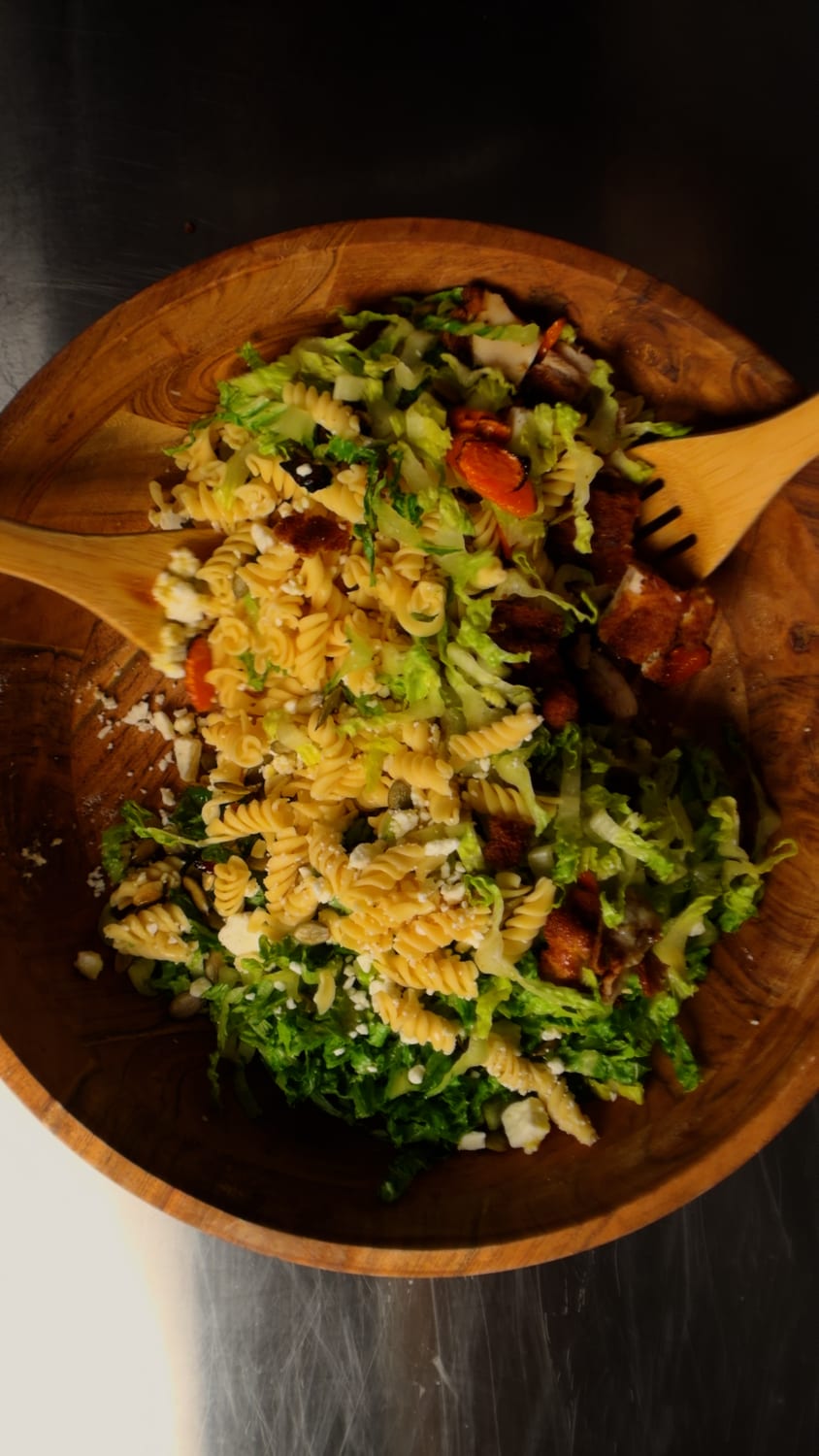
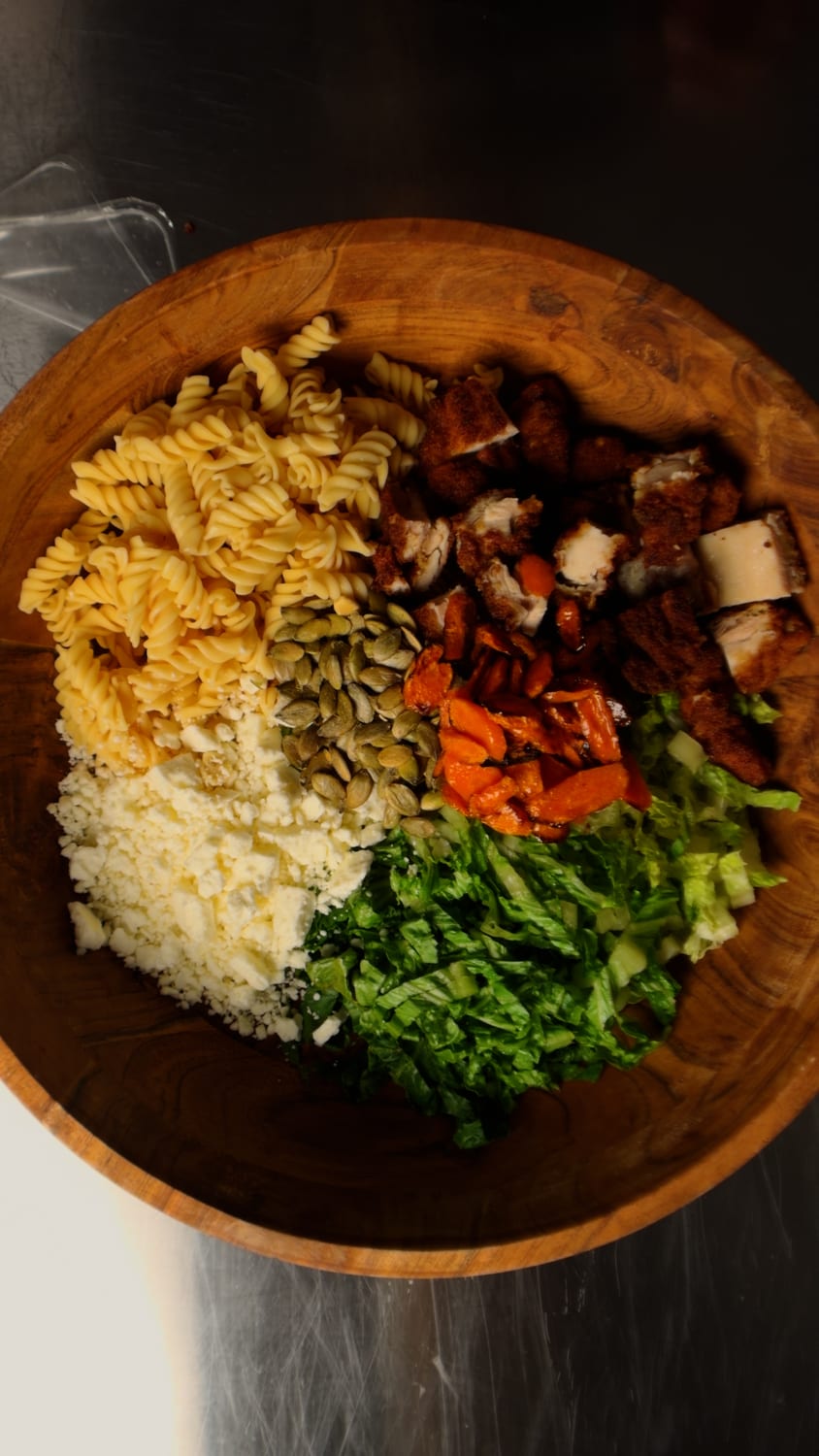
Here is the framework on one plate. The Honey Crunch Chicken Salad is a single dish that hits all seven pillars in every fork.
| Pillar | Ingredient |
|---|---|
| Smell | Romaine + dijon mustard's volatile oils |
| Sweet | Roasted carrot coins (caramelized edges) + a teaspoon of honey in the vinaigrette |
| Salty | Crumbled feta |
| Sour | Apple cider vinegar in the vinaigrette |
| Savory | Crispy breaded chicken thigh strips (double-dredged) |
| Spice | Dijon mustard + cracked black pepper |
| Sensation | Pepitas + panko crust + chewy carrot + tender rotini (four distinct textures) |
Seven ingredients, seven pillars. The vinaigrette alone covers three of them. The full recipe with method and ratios is here: The Honey Crunch Chicken Salad.
Once you see the framework, you can apply it to any cuisine. A pasta dish. A grain bowl. A breakfast plate. A sandwich. The pillars are the same. The ingredients change.
Further reading
Every claim above maps to a peer-reviewed paper. Each is searchable by PubMed ID at pubmed.ncbi.nlm.nih.gov.
- Smell. Shepherd, G.M. (2006). Smell images and the flavour system in the human brain. Nature, 444, 316–321. PMID 17108956
- Taste interactions (sweet, sour, salty, bitter). Green, B.G. et al. (2010). Taste mixture interactions: suppression, additivity, and the predominance of sweetness. Physiology & Behavior, 101(5), 731–737. PMID 20800076
- Salt suppresses bitter. Breslin, P.A.S. & Beauchamp, G.K. (1995). Suppression of bitterness by sodium: variation among bitter taste stimuli. Chemical Senses, 20(6), 609–623. PMID 8788095
- Umami / taste receptors. Chandrashekar, J., Hoon, M.A., Ryba, N.J.P., Zuker, C.S. (2006). The receptors and cells for mammalian taste. Nature, 444, 288–294. PMID 17108952
- Spice / TRPV1 (Nobel 2021). Caterina, M.J. et al. (1997). The capsaicin receptor: a heat-activated ion channel in the pain pathway. Nature, 389, 816–824. PMID 9349813
- Sensation / sensory-specific satiety. Rolls, B.J., Rolls, E.T., Rowe, E.A., Sweeney, K. (1981). Sensory specific satiety in man. Physiology & Behavior, 27(1), 137–142. PMID 7267792
- The multisensory framework. Spence, C. (2015). Multisensory flavor perception. Cell, 161(1), 24–35. PMID 25815982
Dishes to try this on
Weekly articles
Enjoy the science? There's more every week.
New food science article every week. Sign up free to get notified, or go ad-free with membership.
What to read next
Comments
Sign in to join the discussion.Sign in
Members only
Go ad-free for $1/week
Remove all ads across the site, unlock chef's notes and dietary substitutions, and support the science content that keeps coming.
Get Membership