The Perfect Chicken Breast: Tenderize It, Then Cook It Right
Dry chicken breast is not a cook-it-gentler problem, it is a tenderizing problem. Here is the three-way stack (jaccard, baking soda, kiwi) that keeps a lean breast juicy, and why you can safely pull it at 155F instead of 165F.
Charles Kim·Chef Fatty
July 12, 2026
A chicken breast does not have to be dry. You just have to stop fixing it the wrong way.
Dry chicken breast is the most common thing people get wrong in the kitchen, and almost everyone tries to fix it the same way: cook it less. That is the trap. Chicken breast is lean, and undercooking it is both dangerous and, honestly, not even the reason it went dry. The real fix is the opposite of what you think. You do not cook it more gently. You change the meat before it ever hits the pan, so it stays juicy even when you cook it all the way to a safe temperature.
This is a tenderizing method, three different tricks stacked together, and then a cooking temperature most people get wrong. Do both and you get a chicken breast that slices juicy every single time.
Why chicken breast dries out
Chicken breast is almost pure lean muscle. There is very little fat and basically no connective tissue, so there is nothing to lubricate it or hide a mistake. All of its juiciness lives in the water held inside the muscle fibers. Those fibers are like bundles of tiny tubes full of water, and the protein that holds them, mostly myosin, contracts when it heats up and squeezes that water out like wringing a sponge. That squeeze speeds up fast past about 150°F, and by the time most people pull their chicken, well past 165°F, a big share of the water is already gone. That is the chalky, stringy texture.
So there are two jobs. First, change the meat so it holds onto its water even as it cooks. Second, stop cooking it at the right moment instead of blowing past it. The tenderizing handles the first. The temperature handles the second.
Tenderize it three ways
Three tools, three completely different mechanisms: mechanical, chemical, and enzymatic.
What makes this work is that the three tenderizers attack the problem in three different ways, so they stack instead of overlapping. One tears the fibers physically, one changes the chemistry so the fibers stop squeezing, and one literally cuts the proteins apart. Together they let a thick, lean breast stay tender and juicy at a fully cooked temperature.
1. Mechanical: the jaccard
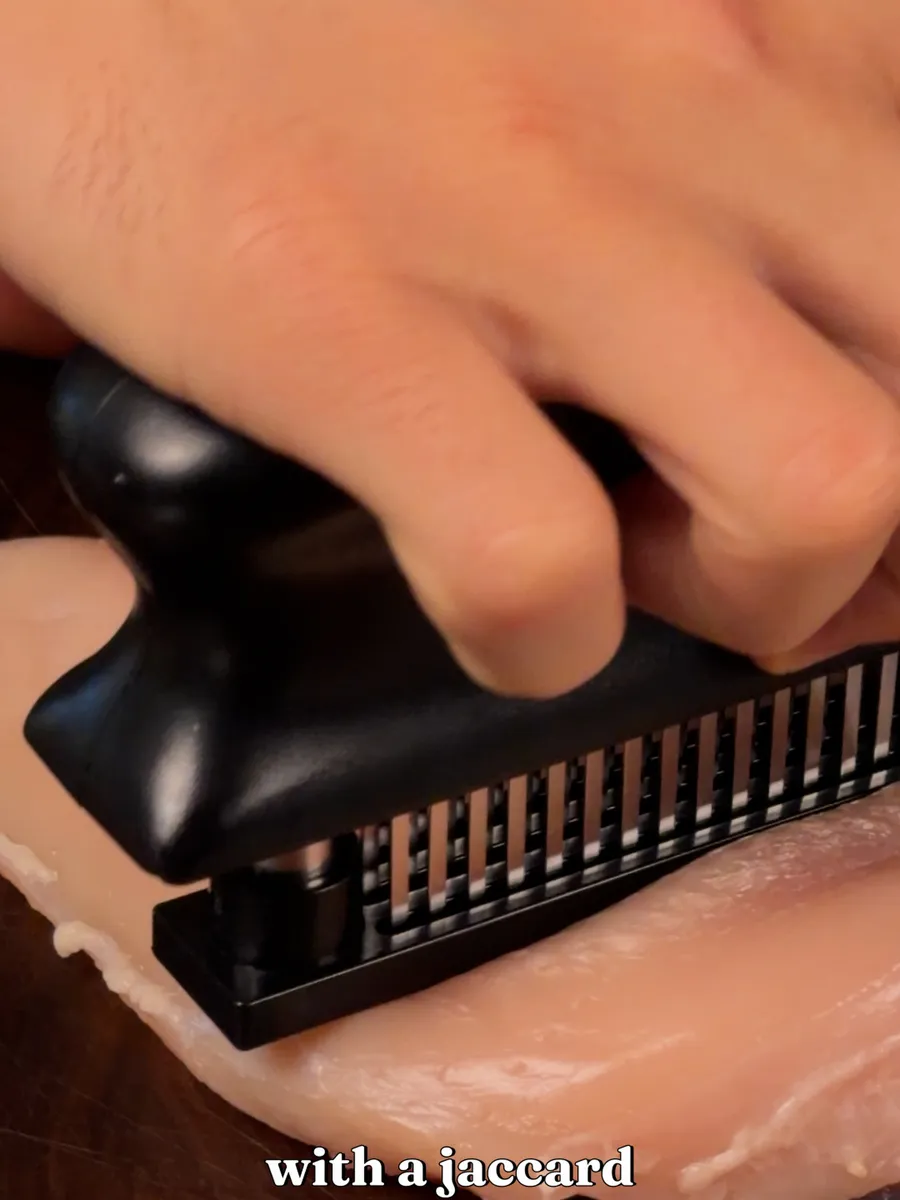
A jaccard drops dozens of thin blades through the meat, cutting fibers and opening channels.
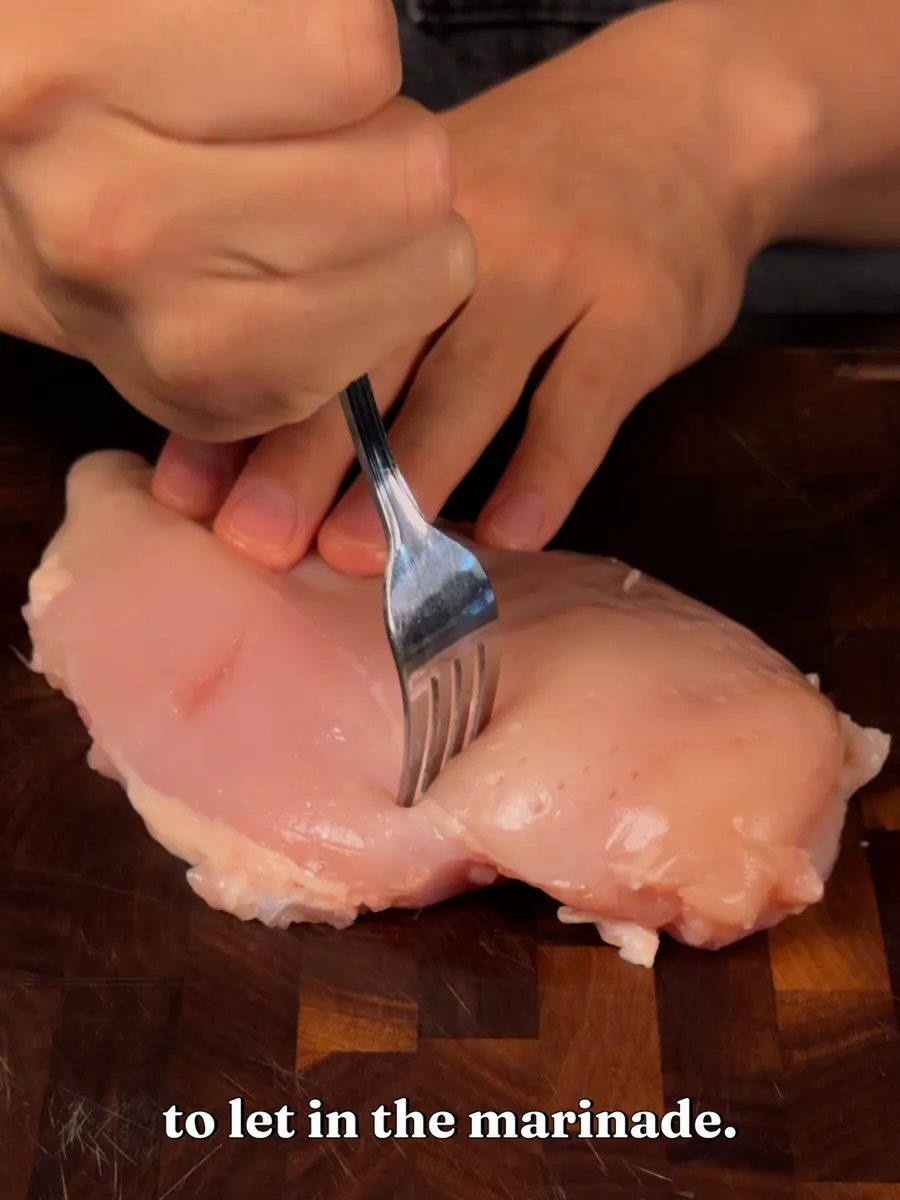
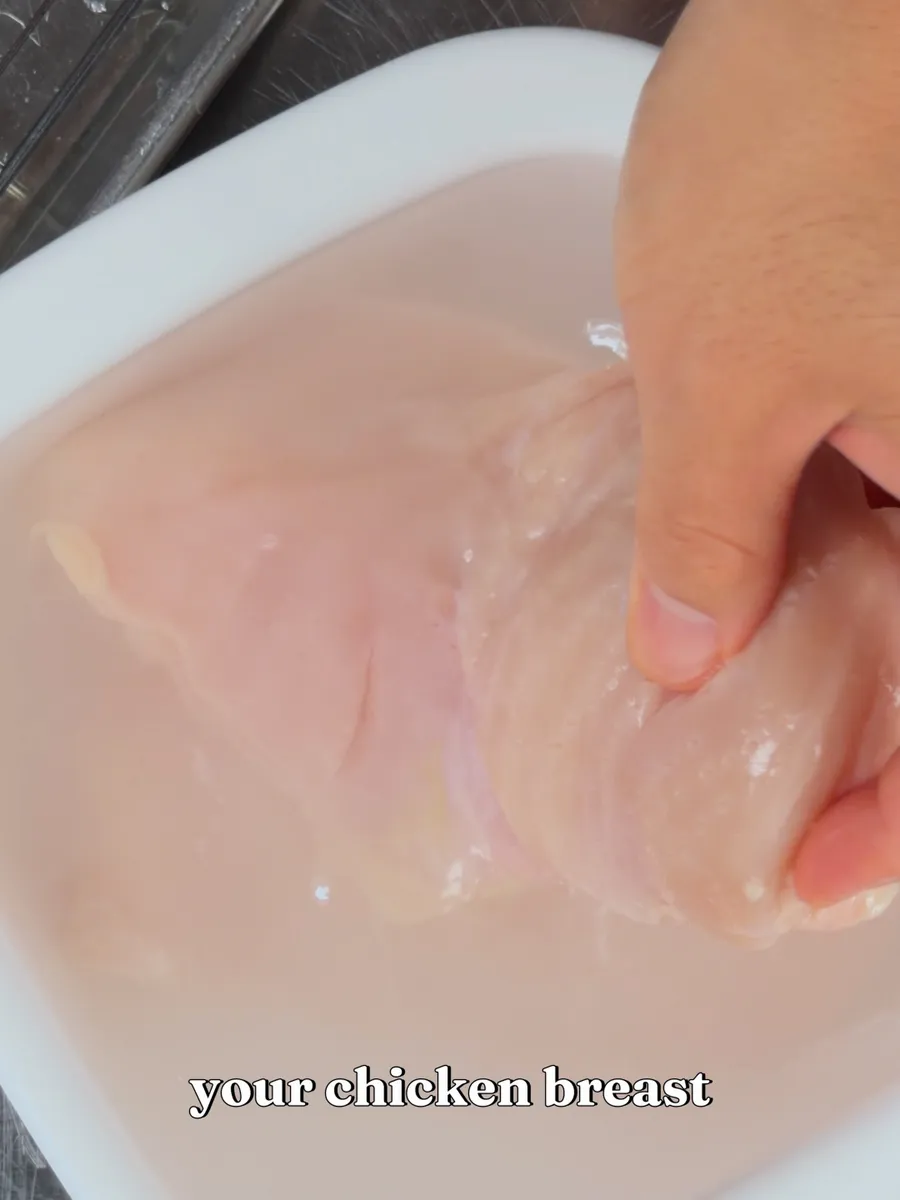
A jaccard is a block of thin blades. Press it through the breast and it severs the long muscle fibers into shorter pieces, which is the most direct way to make meat feel tender, there is simply less to chew through. Just as important, it punches dozens of channels straight into a thick piece of meat. A whole breast is too dense for a marinade to soak into on its own, but those channels give the salt, the baking soda, and the kiwi a way to reach the middle instead of just coating the surface. A fork does a lighter version of the same thing.
No jaccard? A fork opens channels too, so the marinade gets past the surface.
2. Chemical: baking soda
Baking soda is the velveting trick: it changes the pH so the muscle stops wringing itself out.
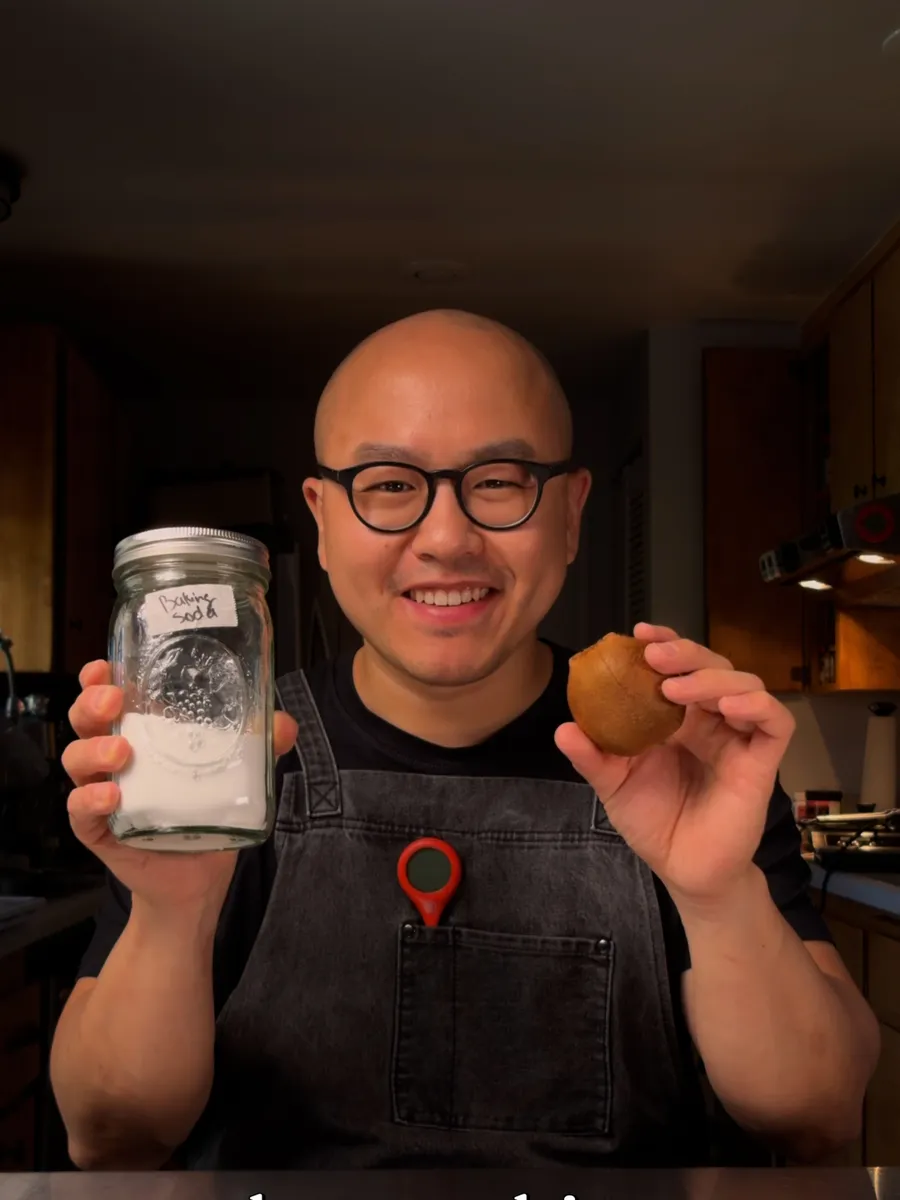
Baking soda is alkaline, around pH 8.3. When it coats the meat, the raised pH disrupts the protein bonds that make the muscle fibers contract so hard when they heat. The fibers still tighten, but far less, so the water stays trapped inside instead of getting squeezed onto the pan. This is the Chinese restaurant trick called velveting, and it is why their chicken is so tender. The rule is a light hand: about a quarter teaspoon of baking soda per pound of meat. More is not better, too much leaves a metallic, soapy aftertaste. On a thick whole breast the baking soda works mostly on the surface and just under it, which is exactly why the jaccard channels matter, they carry it deeper.
3. Enzymatic: kiwi
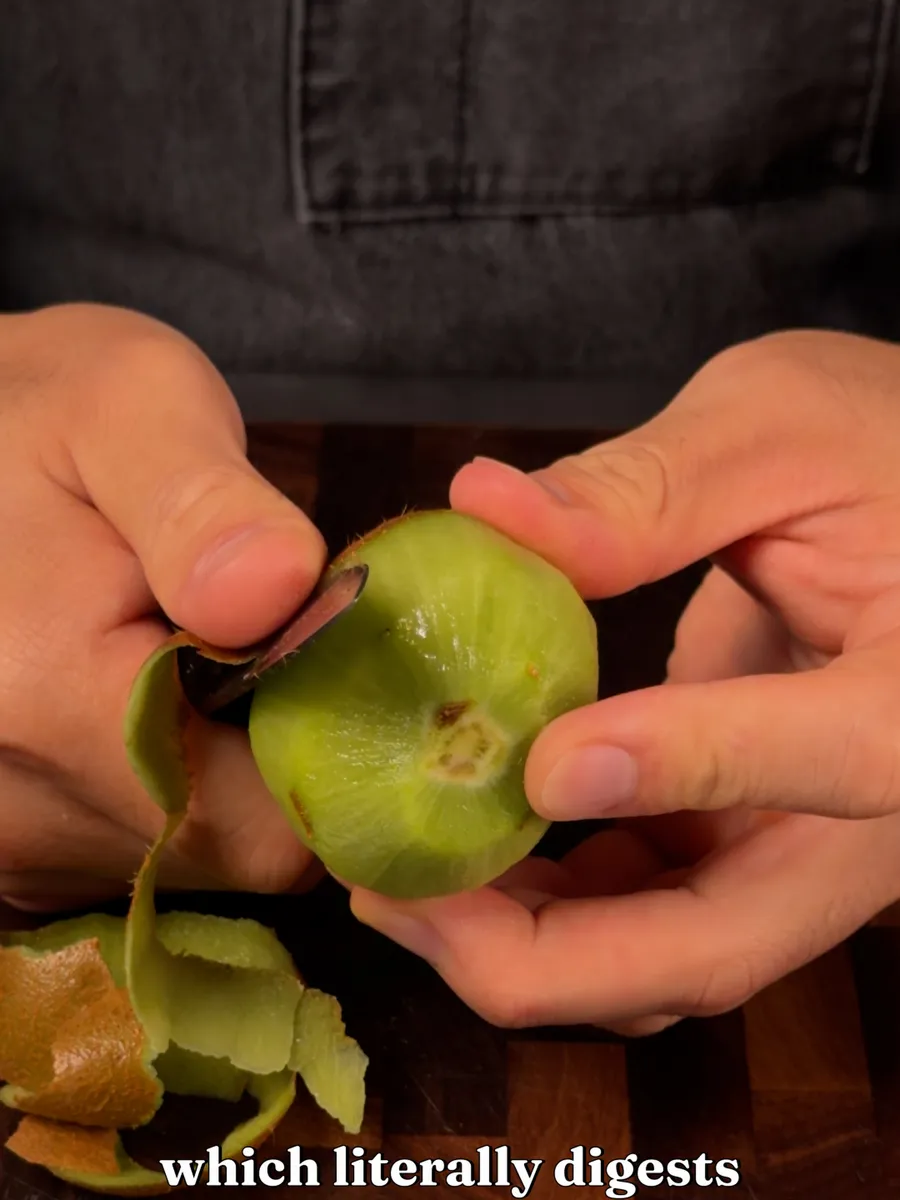
Kiwi carries actinidin, an enzyme that literally cuts the meat proteins apart.
Kiwi is the aggressive one. It carries an enzyme called actinidin that literally digests protein, snipping the long muscle and connective strands into shorter pieces. It is a real, strong tenderizer, one of the strongest you can buy in a fruit. That power is also the catch: actinidin does not stop on its own, and left too long it turns the surface of the meat mushy and mealy. So kiwi goes on a short leash. In this method it is doing its work in a quick fifteen-minute marinade, not overnight. With kiwi, more time is not more tender, it is mush.
The fifteen-minute marinade
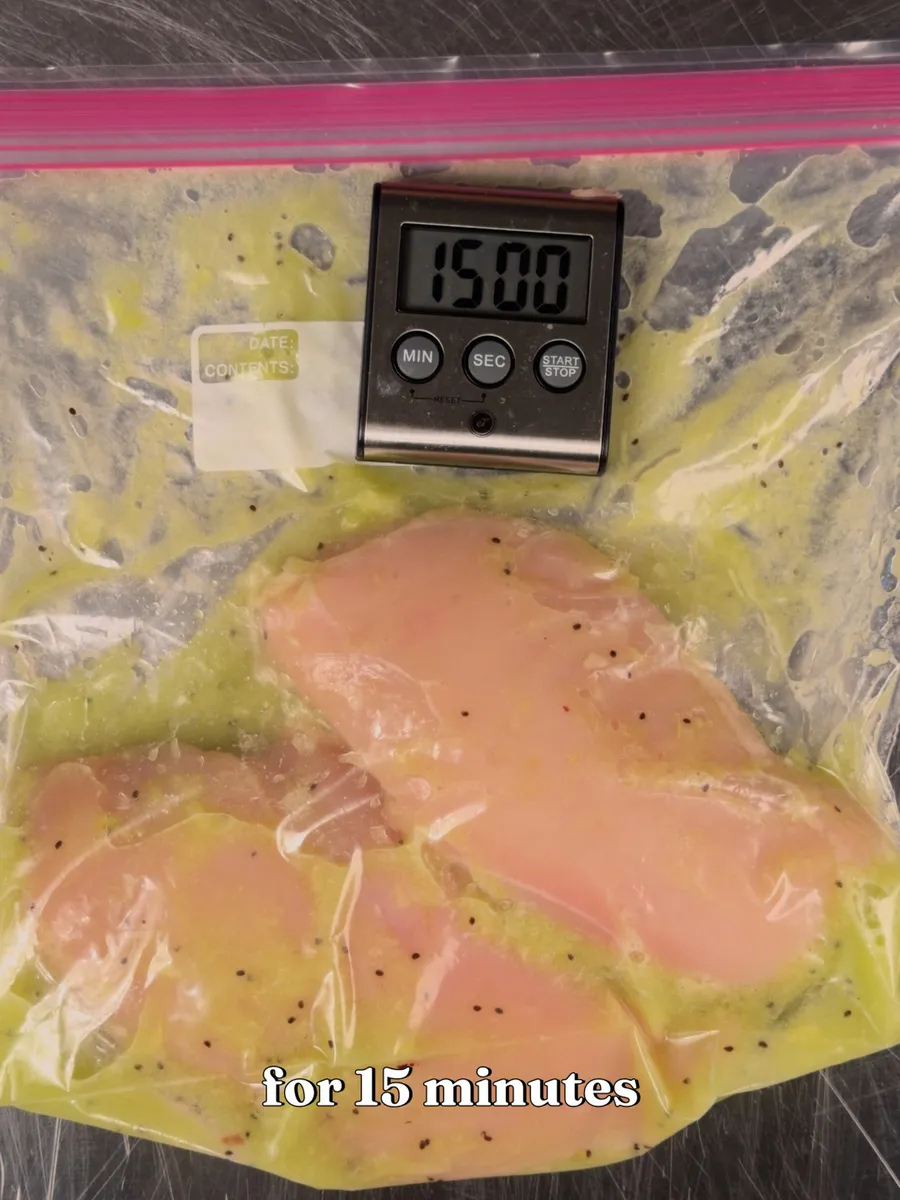
Fifteen minutes, not more. The kiwi is strong enough that longer turns the surface to paste.
Once the breast is jaccarded and coated, everything soaks together for about fifteen minutes. That short window is deliberate. Between the kiwi enzyme and the baking soda, this is a fast, powerful setup, and the channels from the jaccard mean it all reaches deep quickly. Fifteen minutes is enough to tenderize through and through without the surface going to paste. Set a timer and do not wander off.
Cook it to 155°F and rest 5 minutes
Sear it, then pull it at 155°F and rest 5 minutes. That is a fully safe, fully juicy chicken breast.
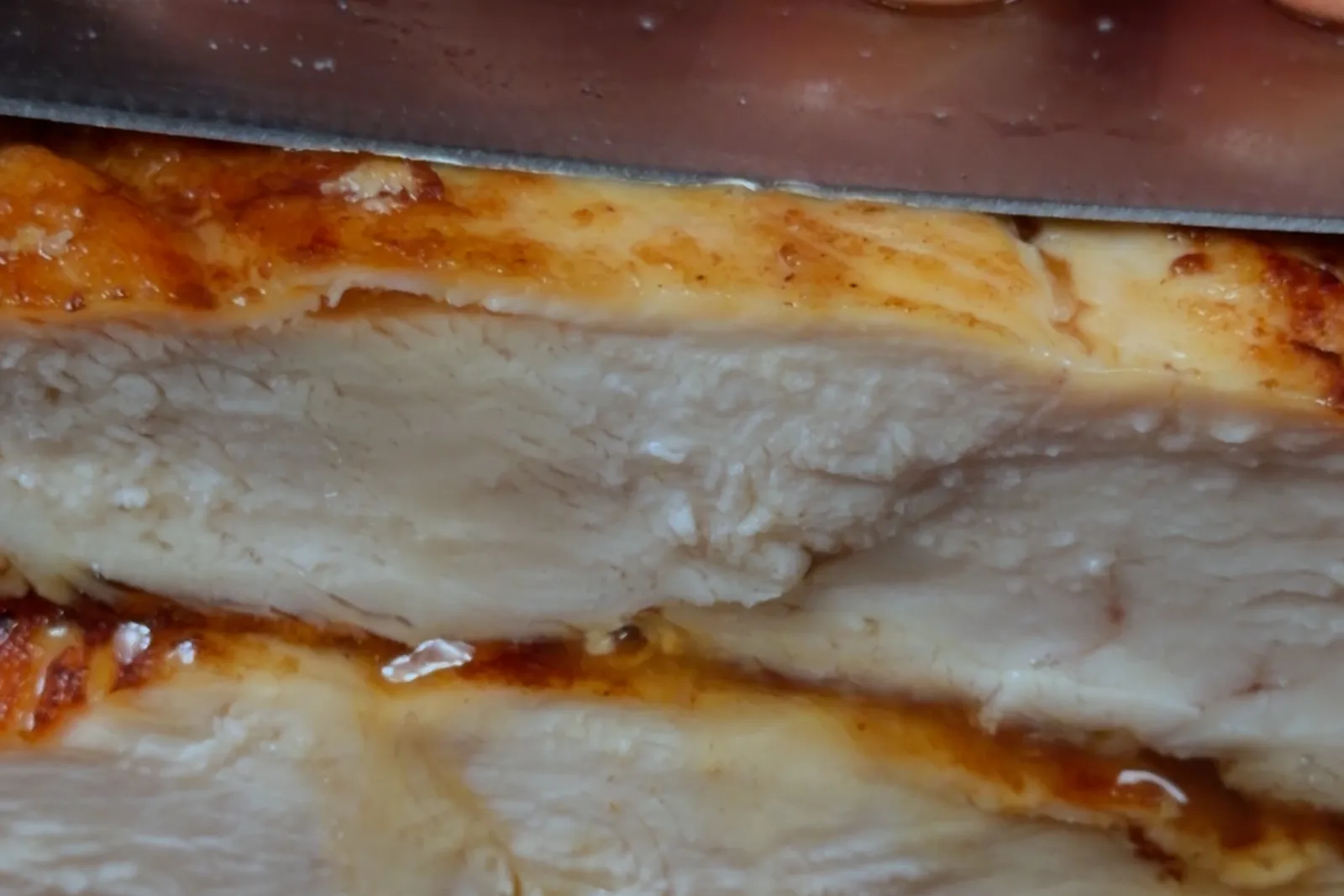
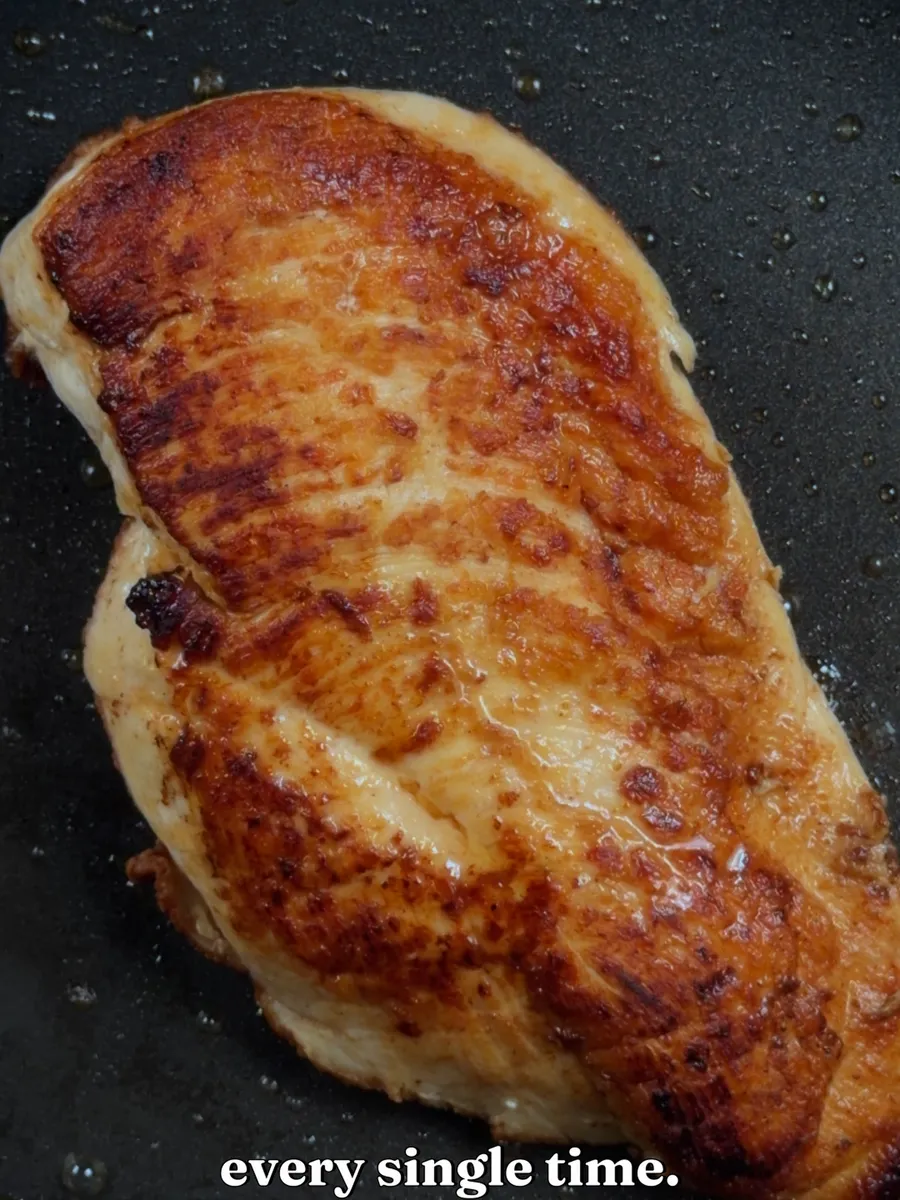
Now the second job: stop at the right moment. Sear the breast for color, bring the center to 155°F, then pull it and let it rest for 5 minutes before you cut. That is it. Because you tenderized it three ways, the meat holds its water and stays juicy at a fully cooked temperature, and because you stopped at 155°F instead of running it to 175°F, you never wrung it dry. Measure the center with an instant-read thermometer, not by look or feel. On a lean breast a few degrees is the whole difference between juicy and chalky.
FAQ: why not 165°F?
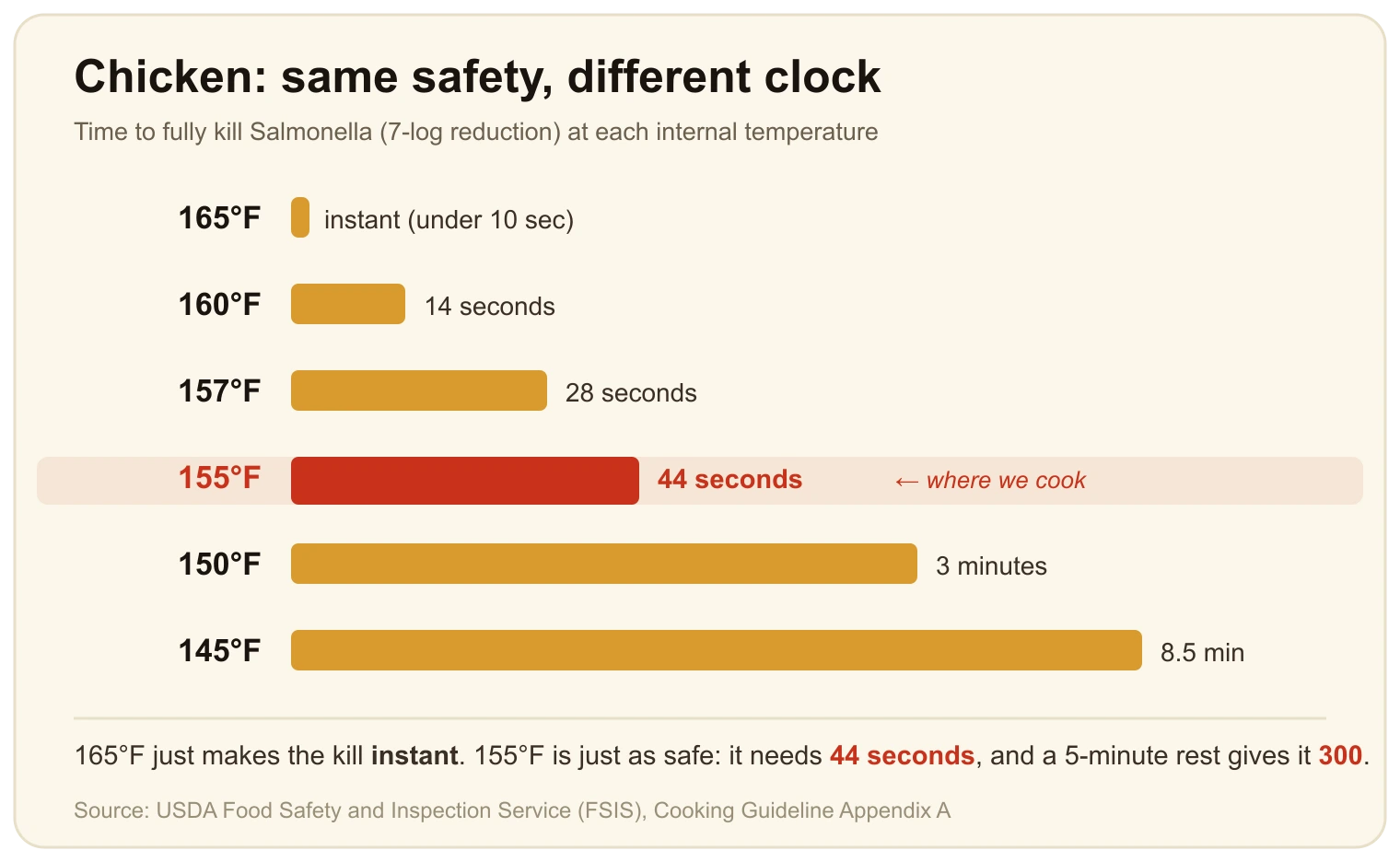
Because 165°F is not a magic safety wall. It is just the temperature where the kill is instant. Food safety for chicken is temperature and time together, not temperature alone. 165°F is the one number the USDA gives everyone because it needs no timing: at 165°F, Salmonella is wiped out in under ten seconds. But the exact same kill happens at lower temperatures, they just need to be held a little longer.
The same safety, on a different clock. Hotter kills faster, but lower and slower gets there too. Data: USDA FSIS Cooking Guideline, Appendix A.
At 155°F, the meat needs about 44 seconds to reach the exact same safety level that 165°F hits instantly. A 5-minute rest holds the center there for 300 seconds, roughly seven times longer than it needs. So a breast pulled at 155°F and rested is fully pasteurized, and it is dramatically juicier because you stopped before the muscle wrung itself out. Lower temperature, identical safety, more juice. That is the whole reason to cook it this way.
One condition, and with this method it is not optional. You tenderized this breast with a jaccard, and those blades carry bacteria from the surface down into the center of the meat. That is fine, as long as the center actually reaches 155°F and holds. But it means you have zero margin for guessing: you must measure the true coldest spot, the thickest part of the center, with an accurate instant-read thermometer. If you do not own one, do not use 155°F. Cook to 165°F, where the kill is instant and timing does not matter. And this whole time-and-temperature approach applies only to a whole, intact breast. Ground chicken, chicken sausage, meatballs, and anything stuffed are always 165°F, no exceptions, because grinding and stuffing spread bacteria throughout the meat.
Cook it right and you never have to choose between safe and juicy again. You get both, every single time.
The recipe
Everything above, in one place. Serves 2, about 25 minutes with most of it hands-off.
Ingredients
2 boneless, skinless chicken breasts (about 1 lb)
1/4 tsp baking soda
1/2 kiwi, peeled and grated or blended
1 tsp salt
1/2 tsp black pepper
1 Tbsp neutral oil, plus more for searing
Optional: 2 cloves garlic, grated, and a splash of soy sauce
Method
Run a jaccard (or a fork) over both sides of each breast to cut the fibers and open channels for the marinade.
Sprinkle the baking soda evenly over the chicken, about 1/4 tsp per pound, and rub it in.
Add the grated kiwi, salt, pepper, oil, and any aromatics. Toss to coat in a bag or bowl.
Marinate 15 minutes, and no longer. The kiwi is strong, and past 15 minutes it turns the surface mushy.
Pat the surface dry so it sears instead of steams.
Sear in a hot, oiled pan until deeply golden on both sides.
Finish gently, lower the heat or cover the pan off the burner, until the center reads 155°F on an instant-read thermometer in the thickest part.
Rest 5 minutes before slicing. That rest holds it at temperature, which is what makes 155°F fully safe.
Safety note. Because the jaccard drives surface bacteria into the center, the center has to actually reach 155°F, and you have to measure it. No instant-read thermometer? Cook to 165°F, where timing does not matter. Ground or stuffed chicken is always 165°F.
Weekly articles
Enjoy the science? There's more every week.
New food science article every week. Sign up free to get notified, or go ad-free with membership.